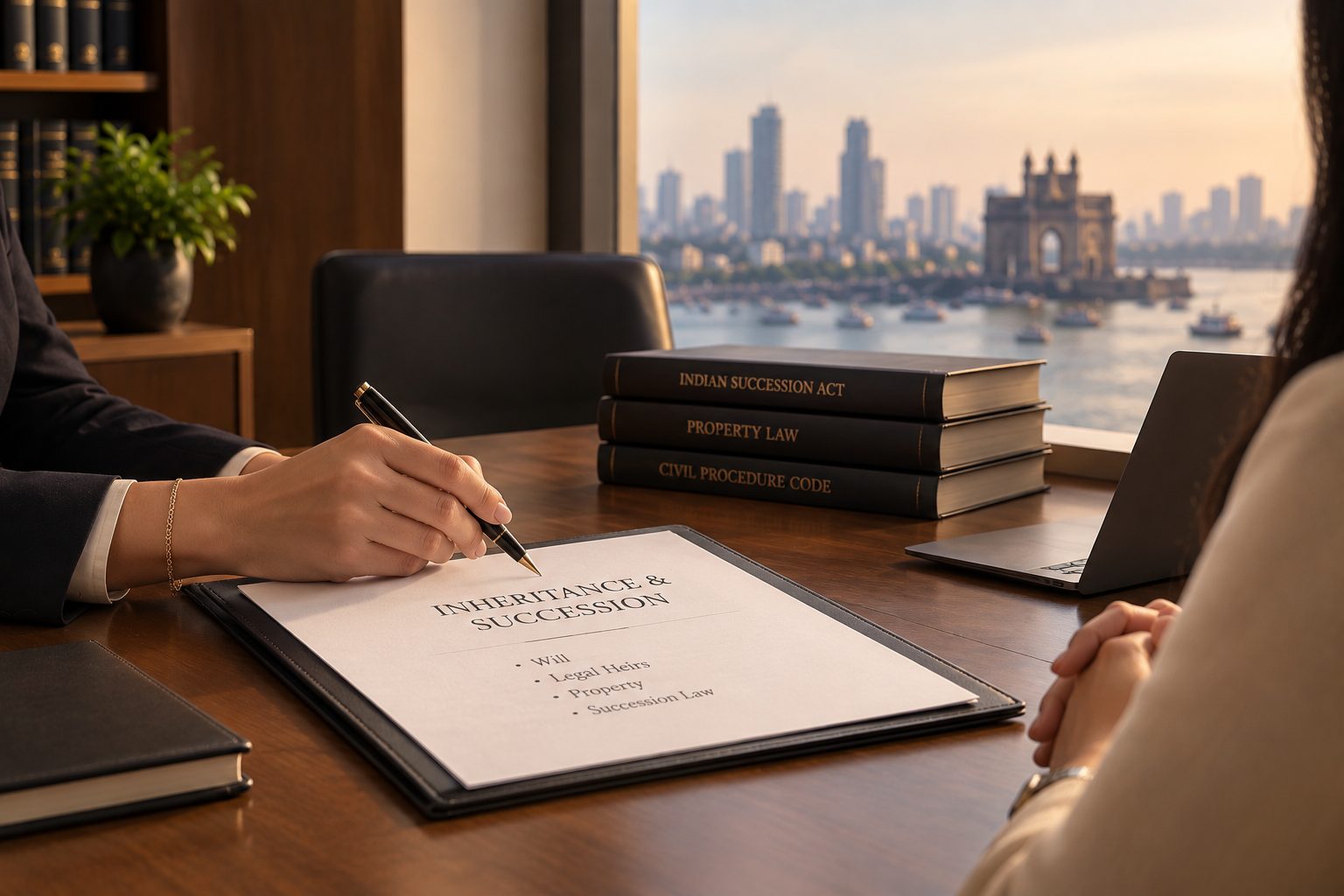
Inheritance of property in India depends on the nature of the property, the succession law governing the estate, whether the deceased left a Will and the identity of the surviving legal heirs.
A legal consultation with an inheritance lawyer in Mumbai generally involves reviewing the relevant documents, family circumstances and applicable legal provisions before considering any course of action. An heir’s rights depend on the facts, evidence, ownership history and governing law.
Eagle Law & Integrity (ELI) handles inheritance and succession-related matters involving legal review, documentation, negotiation or representation before the appropriate court or forum. Its civil litigation practice may assist with inherited property disputes, Will-related proceedings, partition and related civil remedies.
Recent Legal Update
No. Until December 2025, Section 213 of the Indian Succession Act, 1925 meant that an executor or beneficiary under a Will made in Mumbai (or concerning property in Mumbai, Kolkata or Chennai) could not establish their rights in court without probate. The Repealing and Amending Act, 2025, which received Presidential assent on 20 December 2025, omitted Section 213. Probate is therefore now optional. In practice, however, housing societies, banks and property buyers often still ask for probate before they transfer a flat, release funds or complete a purchase, so it frequently remains the most practical way to put a Will beyond dispute.
For contested Wills and probate litigation, see our Testamentary Suits page.
Inheritance matters turn on documents – the Will, if there is one, title papers, family records and any earlier partition or settlement. ELI reviews these first, identifies which succession law applies and who the legal heirs are, and then advises on the options: a family settlement, a succession certificate, probate or letters of administration, or a partition suit.
Inheritance rights in India depend primarily on whether a person dies testate or intestate and which succession law applies. Where a valid Will governs the estate, the deceased’s testamentary wishes generally form the basis for distribution, subject to the relevant statutory provisions and any legal challenge. Where there is no Will, the estate is distributed according to the rules of intestate succession applicable to the deceased.
Statute
The Hindu Succession Act, 1956 provides the statutory framework for several aspects of intestate succession. It contains provisions concerning the succession of heirs and the devolution of interests in certain joint family property.
Practical relevance
The Act may be relevant when determining the applicable heirs, their respective interests and rights in coparcenary property. Section 6 is particularly relevant where the legal character of joint family or coparcenary property must be assessed.
Statute
The Indian Succession Act, 1925 contains provisions relating to testamentary and intestate succession in circumstances governed by that legislation.
Important provisions
Statute
Inheritance among Muslims is governed by Muslim personal law, not by the Hindu Succession Act or the intestate provisions of the Indian Succession Act. Shares are fixed by personal law, and a Muslim can leave property by Will only up to one-third of the estate to persons who are not heirs, unless the heirs consent.
Practical relevance
The Act may be relevant in determining the succession framework that applies to an estate and the procedure required in testamentary or succession-related proceedings.
Each inheritance matter depends on its facts, family circumstances, documents, ownership history and applicable succession law. The process therefore begins with a review of the estate and relevant records before determining the appropriate legal course.
Understand the family circumstances, the deceased’s estate, whether a Will exists, the nature of the property and the client’s concerns.
Review available death certificates, Wills, title documents, family records, partition or settlement deeds, property records, financial records and relevant court orders.
Identify the applicable succession law, surviving legal heirs, ownership history, testamentary issues and any questions concerning ancestral or coparcenary property.
Consider the appropriate course of action, which may include strategic counsel, documentation, negotiation, mediation, family settlement or succession-related proceedings.
If proceedings are required, prepare the necessary documents and represent the client before the appropriate court or forum.
Depending on the matter, assist with settlement, orders, partition, related civil remedies or further proceedings arising from the succession dispute.
Inheritance rights depend on the succession law applicable to the deceased and the identity of the surviving legal heirs. The applicable statutory provisions determine how the estate devolves.
Yes. A Will may be challenged on legally recognised grounds, depending on the facts. Issues may include improper execution or attestation, lack of testamentary capacity, coercion, fraud or undue influence.
Yes. Under Section 6 of the Hindu Succession Act, 1956 (as amended in 2005), a daughter is a coparcener by birth, with the same rights and liabilities as a son. This applies whether or not her father was alive on 9 September 2005, when the amendment came into force – as the Supreme Court held in Vineeta Sharma v. Rakesh Sharma (2020) 9 SCC 1. A partition already completed by a registered deed or court decree before 20 December 2004 is not reopened.
No. Family history alone does not automatically establish the legal character of property as ancestral or coparcenary. Title history, acquisition, partitions, family arrangements and other transactions may need to be examined.
Bring available death certificates, Wills, title documents, family records, partition or settlement deeds, property records, financial records and relevant court orders. Additional documents may be identified after review.
Depending on the circumstances, parties may explore negotiation, mediation, family settlement or other appropriate methods. Whether settlement is suitable depends on the nature of the dispute, the parties involved, and the legal issues.
No. A nominee receives the asset but does not become its final owner. The asset still passes to the legal heirs under the Will or the applicable succession law. The Supreme Court confirmed this for shares in Shakti Yezdani v. Jayanand Jayant Salgaonkar (2023). For flats in Mumbai housing societies, the society may transfer membership to the nominee, but that does not decide who owns the flat among the heirs.
The information on this page is general legal information and is not legal advice or a legal opinion. Every matter depends on its own facts and the applicable law. Reading this page, or contacting Eagle Law & Integrity through this website, does not create a lawyer–client relationship. No particular outcome is guaranteed. Please take legal advice on your specific situation before acting on anything on this page.
Eagle Law & Integrity (ELI) handles inheritance and succession-related matters involving legal review, documentation, negotiation or representation before the appropriate court or forum.
Book a Consultation